
By: Christina Pugh
Personally, I love figs – I grew up with a giant old fig tree in my backyard, and spent hours climbing the tree to harvest figs every July and September (if you didn’t know, some fig trees have two growing seasons). I enjoyed them fresh, broiled in the oven with goat cheese, and my favorite – my mom’s homemade fig jam on buttered toast.
My delicious breakfast aside, figs can be a controversial fruit for people. The thick skin, the crunchy seeds inside, and the weird slimy texture can gross people out. And while I hate to make figs even grosser than they are for some people – it’s possible that those “seedy” crunches in a fig that you’re accustomed to might actually be the crunch of a bunch of dead wasps. That is at least, if you’re getting the fig from a wild fig tree, because the way that these fig trees become pollinated is one of the most freaky and fascinating in all of plant biology (in my “expert” opinion).
_fruit_halved.jpg#file)
Pollination requires flowers, right? But in all the years climbing my fig tree, I never saw any flowers on it. It turns out that the flowers on a fig tree are actually inside of every fig. When you eat a fig, each little seed was once a tiny female flower. Male flowers have long stamens that produce pollen, and female flowers house an ovary that, when fertilized, develops into a seed. The outer skin of the fig is great for providing a thick, protective layer for the tiny flowers inside, but it creates a new problem – how are the flowers inside supposed to get pollinated?
Many wild fig species (like the strangler fig and the wild banyan tree) are pollinated through fig wasps. If you’ve eaten one of these, it’s very possible you got some extra insect protein with that fruit. The fig wasp’s life cycle relies entirely on figs, of which each tree species has its own specialized wasp species. Fig wasp pollination is a beneficial reproductive method for a variety of different reasons, like improved genetic variety. But how does this pollination end up with possible bugs in my jam?
First, the female flowers inside an immature fig emit an aroma that attracts female wasps specific to that fig species. Then, a fertile female wasp covered in pollen (we’ll get back to how that happens) crawls inside a small opening in the fig called the ostiole. This hole is very small, and the wasp often loses her wings and antennae in the process. She won’t be needing them anymore, anyways. The wasp crawls around inside the fig, pollinating many female flowers and laying eggs inside some of them. Having completed her mission, the wasp dies.
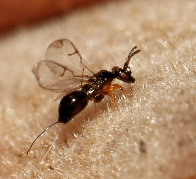
The eggs eventually hatch as larvae, eating some of the floral tissue as they develop. Once adults, the male wasps mate with the female wasps, chew an exit tunnel out of the fruit, then die still inside. The only wasps to leave the fruit are the female wasps, now fertilized and covered in pollen from crawling around inside the fig, ready to enter and pollinate new figs.
This mutualistic relationship requires both the fig tree and the wasp to hold up their end of the deal. The wasp must successfully pollinate the fig, and in turn, the tree allows the fig to grow to maturity. In fact, scientists discovered that in some cases fig trees will intentionally drop the fruits in which a wasp has laid eggs but failed to bring pollen, effectively killing the whole wasp generation in that fruit.
So, are figs vegetarian? Short answer, probably. Among the wild species that are pollinated by wasps, the answer is no. The female wasp that initially laid eggs in the fig is completely digested by an enzyme the fig releases called ficin. However, you may remember that the male wasps die inside the fruit – they are likely still undigested, as this stage of the wasp life cycle happens closer to when the fig is fully mature. However, the commercially cultivated figs that most humans eat (from the species Ficus carica, like the common fig and the black mission fig in my backyard) do not need to be pollinated to produce fruit, so they don’t rely on wasps. That weird slimy texture and unsettling crunch is just the price you pay for a delicious, bug-free fruit. (And seriously, they’re delicious).
Pugh Kitchen Fig Jam
4 cups of figs, quartered – our tree is black mission figs
2 cups of sugar
Juice of a lemon
Optional add-ins (pick one or 2!):
- Shot of whiskey or rum
- Tablespoon of vanilla
- Cook with a bay leaf
- Add a chopped jalapeno to create a spicy version
- Add warm spices: cinnamon, cloves, allspice
- Grated fresh or powdered ginger
Can do a low sugar version – will need more cooking time and maybe a little powdered low sugar pectin to achieve desired consistency
Cook at medium heat until figs start to break down. Use potato masher or immersion blender to get desired consistency/texture. It will get thicker as it cools – add water if it’s too thick. Take a small amount out of the pot and cool to test consistency.
To jar: ladle hot jam into hot, clean jars (easier to do with a funnel). Top with a hot lid and hot ring. (I have a big pot of boiling water for the jars and a second one of lids and rings. Use tongs to remove items from boiling water and place on a towel on the counter to fill.) Hand tighten the ring, then flip upside down on a clean towel and let cool undisturbed for 12 hours. Check the seal of each jar (should be concave and rigid). Any unsealed jars can be stored in the fridge and used.
Can also freeze in a plastic container or will keep in the fridge in a jar for a couple of weeks.
Christina Pugh is a 21 year old biological sciences student at the University of Pittsburgh. She has a huge love for the natural world and ecology, and hopes to make a career in research and conservation.
 Plants in the Foreground
