
By: Stella Abrams
Last summer, I studied abroad in Sicily. I got off the plane, groggy, but excited for what was to come. Not knowing what to expect, I got in the van with the rest of the group ready to see this new world. As soon as I saw the Sicilian landscape, I was, to my surprise, drawn back to the summers when I would visit my grandmother in Arizona. Arriving similarly groggy, I would hug my Nani, and we would get in the car. The view on the drive from the Phoenix airport to my grandmother’s home in Prescott was a sea of red rock and sand speckled with small bites of green, the cacti, specifically, the prickly pear.
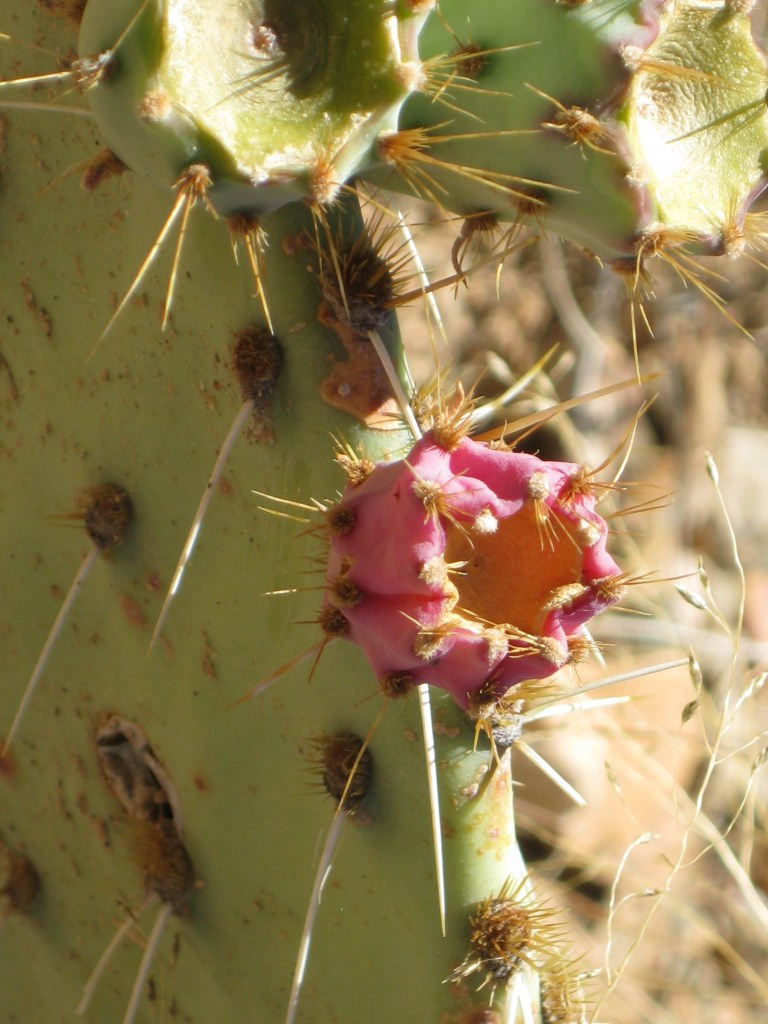
If you can believe it, when I got off this long international flight, I saw again, a prickly pear, or “fico d’India” (fig of India) as the Italians call it! This spiky plant immediately made Sicily feel a little bit more like home. The question arose in my mind, however: how did it get there?
Prickly pears are a group of cactus species native to the Americas, all the way from South America to Canada. The classic prickly pear that I remember from Arizona is actually a different species than the one in Sicily, but they carry many of the same traits and belong to the same genus (Opuntia), meaning they came from a common ancestor. While the travels of this plant have not been significantly studied, one theory is that Spanish settlers brought it from their travels in South America to Sicily. There, it found a home in the Mediterranean climate. But what about these plants allows them to survive in this kind of environment while others cannot?
A very important adaptation that cacti have is a particular form of photosynthesis called CAM (Crassulacean Acid Metabolism) photosynthesis. Remember that photosynthesis is a process that requires gas exchange: carbon dioxide needs to enter the plant, and oxygen needs to leave the plant. These gases are exchanged through tiny holes on the surface of the plant called stomates. These stomates, however, can also let water escape when they are open. Most plants lose around 97% of the water they take up through these holes! In dry environments, this becomes a serious issue because the plant does not have a lot of water to begin with. The adaptation of CAM photosynthesis circumvents this issue by closing the stomates during the daytime when it is hot and opening them at night when it is cooler to allow gas exchange for photosynthesis while minimizing water loss. Because Sicily is hot and dry, these prickly pears that perform CAM photosynthesis survive very well there.
Furthermore, these cacti also became culturally significant in Sicily. They littered the side of the famous Mt. Etna, and they became a popular food. The fruit and flesh of the prickly pear is a food eaten in many other places as well, including back in the United States. Check out this video if you want to see more!
You may be wondering… “wait, but why do they call the prickly pear the ‘fig of India’?” And the answer to that question is actually very simple. When Europeans first started to explore the Americas and thought they had travelled to India, they named the plants and fruits accordingly. Apparently, the name, like the plant, has carried on throughout all of this time and over several continents!
Stella is a 21-year-old biological sciences major at the University of Pittsburgh. She is graduating this semester and is excited to start work in the non-profit realm. She is passionate about the world and the climate, and hopes that plant visibility will make more people passionate too.
 Plants in the Foreground
Leave a comment