
By: Jessica Pecore
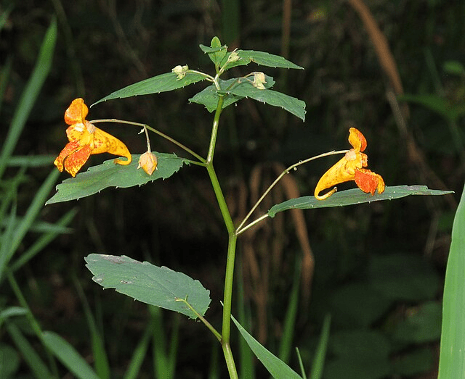
I do not have many memories from my childhood where my family was all together. There are five people in my family: two parents, two older brothers, and me, the youngest daughter. My dad was usually travelling for work, and one of my brothers has special needs that required him to go to a lot of appointments, and sometimes in-patient stays. The positive memories that I do have of the five of us together mostly include outdoor adventures. Sometimes that looked like spending a week at a national park out west, and other times it looked like just taking a walk on a trail twenty minutes from our house. One plant that I remember seeing over and over amidst our outdoor time is jewelweed, or Impatiens capensis, pictured on the left. I remember it so distinctly because my brothers and I treated it like a toy. My mom had shown us that when any pressure is applied to the plant’s seed pod, the pod bursts. What did my brothers and I do with this information? Our response was to make as many pods burst as possible. We could not get over the sensation of a plant exploding against our hands! We only had so many shared positive experiences, given that our family was being pulled in different directions. I think being able to share childlike wonder over this plant gave us something to bond over. To this day, I feel a sense of tenderness and nostalgia when I think of jewelweed.
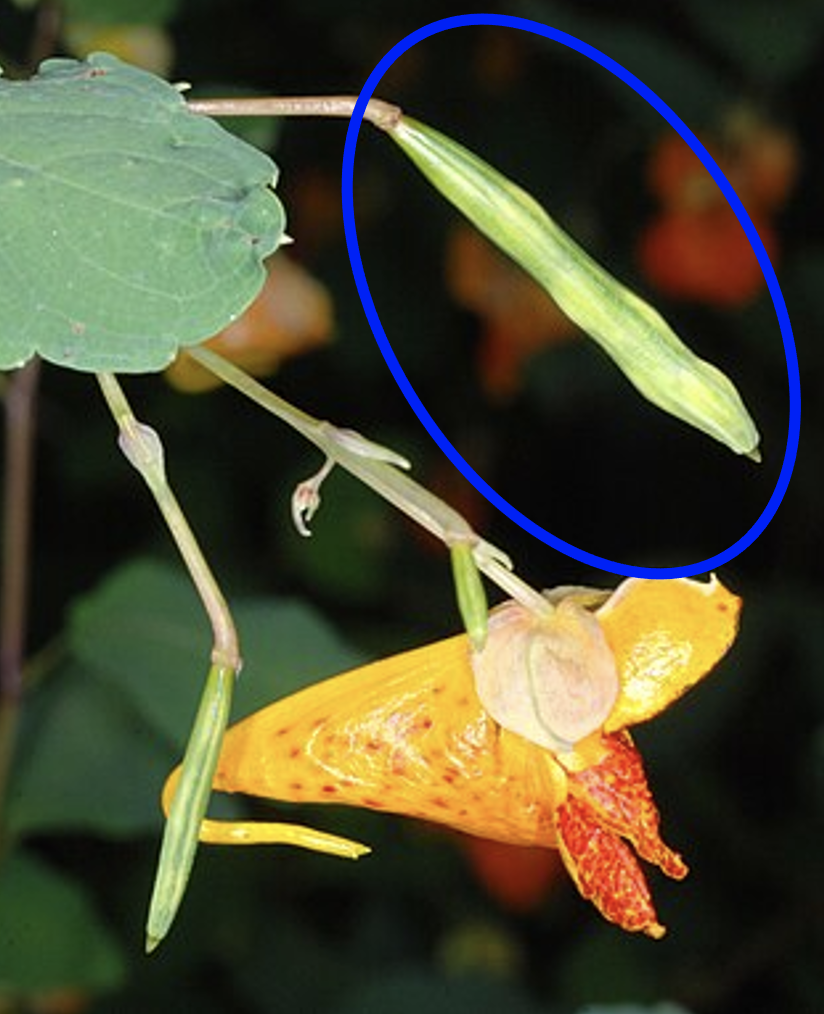
Now that I am older, and majoring in ecology, I have a greater interest in the actual science of this plant. I have learned that the explosion is not just a fun phenomenon. It is actually a reproductive strategy, termed ballistic seed dispersal, and it is used by many plant species. Using force to shoot seeds significant distances, as opposed to dropping them with gravity, increases the range at which an offspring can establish itself. When individual offspring are able to grow further from their parents, they escape having to compete for resources, and the population as a whole can increase its range, too. Thus, ballistic seed dispersal is considered to be an evolutionary adaptation. It is made possible by the storage of mechanical energy in tissues of the seed pod, which is circled in blue in the photo to the right. Each seed pod is made up of five different sections of one tissue type. These sections are called valves, and they are where the mechanical energy is stored. When the seed pod is disturbed, by touch or some other movement, the valves split from each other. After splitting, the valves coil in on themselves at high speeds. This rapid coiling transfers kinetic energy to the seeds, propelling them away from the plant. The process takes less than one hundredth of a second and can send seeds farther than five feet! The split and coiled seed pod and its seeds can be seen in the photo below.

While the physical dispersal power of jewelweed is remarkable, its power to bring people together is just as noteworthy. What is a perfectly reasonable phenomenon when thought of through a scientific lens was once an indescribable magic that awed my family. Experiencing that magic is a memory that has stuck with me through my twenty-two years of life, and it ties me to my family to this day. I imagine there are many cases, in addition to jewelweed, in which a plant has the power to bond people.
Jessica Pecore is 22 years old and studies ecology & evolution at the University of Pittsburgh. She grew up in a family that had an appreciation for nature, so she has them to thank for her environmental passion today. She wanted to express that gratuity and explore how plants contribute to interpersonal relationships in this post!
 Plants in the Foreground


Leave a comment