
By: Sam Hickman
Disclaimer: Sassafras tea made directly from sassafras roots contains the compound safrole, which has been classified as a carcinogen and banned from use in human food by the US FDA. Please consult a medical professional before attempting to consume sassafras tea.
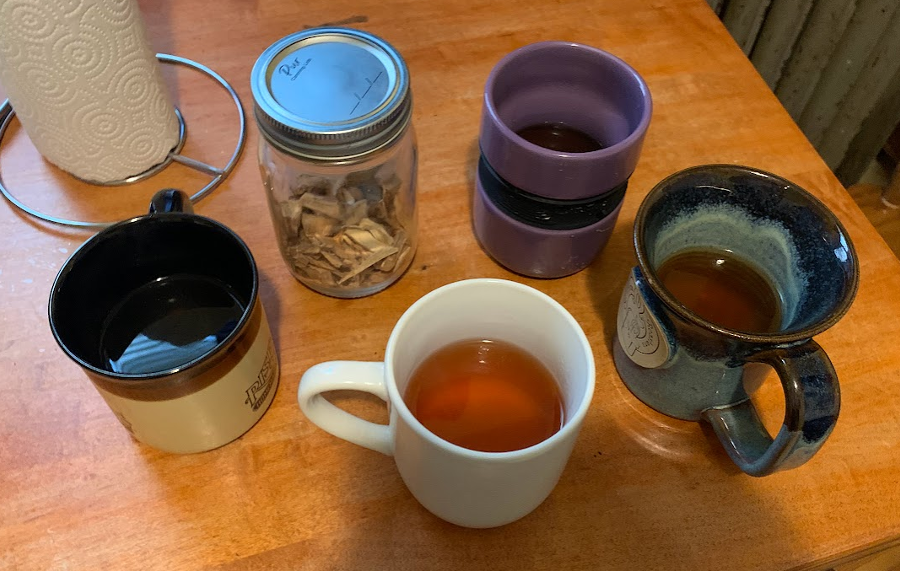
Without even realizing it, I’ve used sassafras tea to make connections all throughout my life. It started when I was a kid, and my family would have holiday picnics at my great-grandma’s house, which was a lot of fun for us kids since we would always get to explore the woods behind the house. My cousins and I would run around looking for turtles and toads, and we would eat as many black raspberries as humanly possible and get our hands all scratched up from the thorns. We’d tire ourselves out, then come back to the house where our parents were waiting just beyond the sassafras trees.
On more than one occasion, one of my grandma’s siblings made sassafras tea from the roots of the trees that were in the backyard. This way of making sassafras tea has been in practice in North America for centuries, with Native American tribes being the first to develop it. Sassafras tea is a bit of an acquired taste; I definitely didn’t like it when I was younger. It tastes kind of bitter and syrupy at the same time in a way that isn’t very inviting to the unfamiliar palate, especially if you don’t add any sweetener.
It does, however, taste remarkably like root beer. This is because the sassafras root was the original flavoring agent of root beer until it was banned by the FDA for containing the chemical compound safrole, which has some carcinogenic properties. Nowadays, commercially sold root beer and other sassafras flavored food contains sassafras extracts without the safrole. That said, my opinion is that the chance of natural sassafras tea or root beer made from sassafras causing cancer is very low since it’s only been shown to be a weak carcinogen in rats.
Roots of trees and other plants have many functions, one of which is storage. For example, maples store most of their water and sugars in their roots over the winter. One of the things that sassafras stores in its roots is safrole, the compound that gives root beer and sassafras tea its distinct taste. Like with other chemical compounds or ‘secondary metabolites’ that plants produce, it is thought the tree makes and stores safrole as a chemical defense against harmful insects or pathogens.
Another function of some roots is propagation. Some plants, like aspen trees and sassafras, can form buds on their roots which can grow into whole trees that are clones of the first tree. Aspens, in particular, are famous for this, but sassafras too can clone itself and give rise to many other trees in this way.
These two functions of sassafras roots, though they serve very different purposes to the tree, look similar from my perspective. Sassafras uses its roots to propagate itself and, in doing so, creates a whole group of trees. At the risk of anthropomorphizing, it seems almost as if the tree is building a community or a family to live among. And thanks to it storing safrole in its roots, sassafras builds community for humans, too. Sassafras tea, for me, has never been an individualized activity. It’s always helped me make or strengthen my connections with other people.
The summer after my freshman year of college was really the first time I was living with my dad after my parents had gotten divorced the summer before. I’ve always been very close with my mom, so not living with her felt really lonely. One day, she and I were on the phone together, and she told me about her plans to go over to my great-grandma’s house, and dig up some sassafras root to make tea. A few days later, she came over to my dad’s house and dropped off a jar of dried sassafras root. The bitter, syrupy, root beer-y taste had never been so sweet and nostalgic as it was then.
Another time that sassafras helped me connect with people was during a summer I spent taking a field botany class, which included three weeks in the woods with a bunch of other college students whom I had never met. One person from that class knew how to forage for sassafras roots, and so one day he went and dug a bunch up. He and a group of us stole some coffee filters from the dining hall and made a very convoluted filtration device with some tongs and clothespins, and we all had tea together. Most of us had never had sassafras tea before, so we sweetened it with brown sugar. And of course, more went into forming friendships with my classmates than just drinking tea together, but this was a foundational experience of those friendships.
So next time you drink root beer or a sassafras-flavored tea, drink it with a friend. The memories will be so much sweeter because of it.
Sam Hickman studies ecology at the University of Pittsburgh, where she works in the Ashman Lab as a research assistant.
 Plants in the Foreground
Leave a comment